by Judy Barker Kvinsland
Inspired by Kelly Corrigan’s Tell Me More: Stories About the 12
Hardest Things I’m Learning to say
It’s Like This. This is it.
By the time I ventured out in 2020, on my first foray away from the safety
of our newly quarantined home, it was the middle of March. As I drove
toward our neighborhood grocery, a little over a mile away, I barely noticed
the lemon-hued forsythia blooming on the corner, the first harbinger of
spring in my eastern Washington neighborhood. I overlooked the newly
unfurled, linden leaves that lined familiar streets, bursting open to provide
welcome shade from the spring sunshine.
I was too focused on survival to notice anything around me. I gripped the
steering wheel and wondered if my tattered, misshapen N-95 mask, found
wadded up in our garage cupboard next to paint cans, would be enough
protection from this mystery called Covid-19.
Instead, I clutched our grocery list, compiled after a walk-about with my
husband as we surveyed our kitchen shelves, pantry, refrigerator and
freezer, taking stock, “What do we have? What do we need?” How naive of
us, I now recall.
The shelves of Yoke’s Market were stripped of every item on my list: no
toilet paper, paper towels, or any other paper product. No peanut butter or
rice cakes, to slather it on. No cleaning or sanitizing solutions of any kind.
No 7-grain bread, diced tomatoes, cheese, bananas, or fresh fruit and
vegetables, staples in our home. I snatched up a pound of chicken breasts
and one box of frozen Garden Burgers and waited in a long line to pay for
my two items. On my way out of the store, I crumpled up my original,
lengthy list and stuffed it into a pocket.
When I returned to my car and pushed the ignition button, the radio broke
the morning silence to announce, “As of today, March 15, 2020,
Washington, California, Massachusetts, New York and Colorado lead the
country in diagnosed cases of Covid- 19.” My head slumped onto my chest.
Everyone I loved, everyone who was close to me, lived in Washington,
California, and Massachusetts, three of the five states.
After my husband surveyed my single sack and searched for peanut butter,
he looked at me and wondered, “What’s going on? Where have you been?
Why didn’t you get the stuff on the list?”
Disheartened after my unsuccessful forage and aware that there would be
more days like this one, I sank into a chair and sighed, “It’s like this. This is
it.”
No Words at All
Only a few weeks earlier, I had finished reading Kelly Corrigan’s bestseller,
Tell Me More; Stories About the 12 Hardest Things I’m Learning to Say, a
reflection of simple phrases and words that “pass between people, that
make love and connection possible.” What are the situations that require the
hardest and most potent things we might say to each other, even when
difficult? How do we sustain relationships and distill moments to their
essence?
Our extended family was already grieving before the first Covid 19 death
was recorded on February 29 in Seattle, which would become an epicenter
for one of the earliest outbreaks in our country. Our dear cousin, who lived
there, had died two weeks earlier, after a valiant struggle to stop the
progress of pancreatic cancer.
I recalled our last goodbye in September of 2019. I recalled our last lunch
and conversation reflecting upon fifty years of summer vacations on Puget
Sound, shared in family cabins built near each other.
“I hoped that I would live long enough to vote in the upcoming presidential
election. But it’s starting to look like I won’t be able to make it that far.”
We hugged each other, no words at all.
Later, I sent a check to the Biden Victory Fund. It felt like a vote.
I Don’t Know
On the same day that the governor of the state of Washington issued an
edict to close all schools, ban all large gatherings, and shutter all but essential businesses, my publisher released my first book, Disturbing theCalm: A Memoir of Time and Place. Essential businesses did not include bookstores, although one might disagree. I recall that I strongly did.
After four years of writing and revising, I finished my collection of inter-related personal essays in the fall of 2019. My memoir was a reflection of how memories of significant persons and specific places can be called upon to give us strength, inspiration and insight as we maneuver through turning points in our lives. Set within the context of historical events, including Title IX, I wanted my book released in March, during Women’s History
Month. Little did I know that the event space where I planned to celebrate
with readers at a release party would lock its doors. Little did I know when
I chose that date, bookstores where I hoped to sign copies, would close. I
was devastated. By delaying the release date, I had created this mess for
myself.
I winced when a friend joked, “Hey, it must be great to have a book out
with the title, ‘Disturbing the Calm!’ This pandemic sure disturbed our
calm.”
“No,” I replied, “It’s really not that great to have a book released right now,
not at all.”
Later the same friend consoled me, “I’m going to buy one, for sure. But not
online, I don’t like online shopping. When will bookstores open up again?”
I whispered, “I don’t know.”
I Was Wrong
Within a few days, I realized that I was wrong.
I had underestimated the interface of a sudden pandemic with folks
quarantined at home, now furloughed or unemployed from their present
jobs, with time to read and already comfortable in the vast culture of
shopping online. Several hundred books sold in just a few days, from online
retailers, primarily Amazon. Perhaps readers, unlike my anti-online friend,
just added my book to their queue, while ordering cases of paper products
and jars of peanut butter.
My inbox quickly filled with heartwarming messages:
“Just ordered mine! A good read for when I self-quarantine!”
“Congratulations! I just ordered a copy. I look forward to reading it!’
“I just submitted a purchase request to our library system, Seattle Public
Libraries!”
“Congratulations! Your new book will be at the top of our reading list!”
“Ordered this morning! Seems like the perfect book to read at this time
of craziness!
Soon deliveries from Amazon slowed because of the volume of orders for
household goods and nonperishable food items. Somehow, my readers
regrouped and sent their orders to Barnes and Noble, who could guarantee
two-day delivery. Clearly, I was wrong.
No
Neighbors who know us well, describe our retirement lifestyle like this:
“Go, Come Back, and Go!”
On New Year’s Day, when I opened the calendar app on my phone and
scrolled through the year, I was reminded that our 2020 travel plans would
not disappoint: meeting authors at the Tucson Book Festival; cruising on a
small ship for two weeks, port to port, along the coasts of England and
Ireland; hiking during our annual trek to Montana; family visits in northern
California; and six weeks in our family cabin on Puget Sound, interspersed
with our grandson’s baseball games, close to home.
Quickly, things changed.
“No, we’re not going to the Book Festival this year,” I lamented, but
recovered when I realized that I still had shelves of unread books and lots of
time to read. Then I discovered Book Passages streamed author interviews
from their San Francisco store, almost like a Book Festival in my own
living room.
“No, we’re not going to England and Ireland this year, “I told a friend. We
were relieved when the trip was cancelled. We committed ourselves to stay
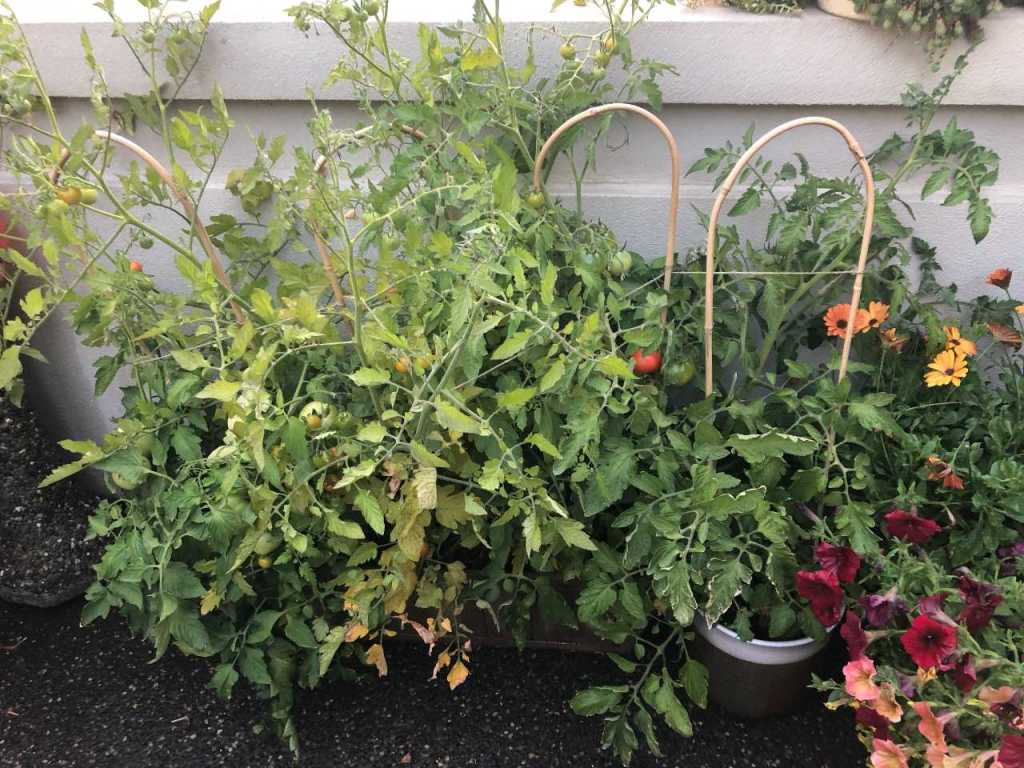
safe and stay local. We planted tomatoes and lettuce among our geraniums and petunias and harvested vegetables around the time we would have been flying to Europe.
“No Montana this year,” my brother and I agreed. We FaceTimed each
other frequently during the pandemic, both of us walking around our
homes, sharing our gardens, vistas, and occasionally, a quick face shot, to
compare whose hair had grown longer and more unruly due to the closure
of salons and barbershops.
“No, we can’t see you this spring, but let’s see how this quarantine goes.
Maybe we’ll be able to get together later in the year?” I commiserated with
my California loved ones. “Let’s set a goal for August at the cabin?”
Baseball season was cancelled.
Tell Me More
We were watching Netflix in early March, a pastime that would later
become a nightly pandemic ritual, when my son’s name popped up on my
phone.
“Mom, we’ve been talking, and while we appreciate how often you help us
with the kids, and how much they love spending time with you, we think we should take a break, until we find out what’s going on with this Covid-19 virus. We feel we need to be more mindful and protective of you and Dad. What do you think?”
I was relieved. I felt the same but did not quite know how to express my
concern.
He continued, “What can we get you from Yokes or Costco? Can you give
me your shopping list, and we’ll drop off what you need. Does Dad need a
prescription filled?”
“No, no, we have everything we need. We’re fine, for a while,” I assured
him. We agreed to assess our self-chosen quarantine in one week. It was not
necessary. In forty-eight hours, the governor closed all schools and
encouraged all but essential workers to stay home.
We worked on our Skyping skills. We worked on our FaceTiming skills. We
learned to Zoom, but it was hard to end those calls and sit alone again without family.
“Tell me more about your new puppy,” I begged our grandchildren. “Tell
me more about your classes online. Tell me more about how you found
those cupcakes you dropped off for my birthday!” We stayed in touch, but
we always wanted more.
Yes. I Love You.
In the middle of August, ten days into our anticipated, two-week stay at our
Puget Sound cabin, we spotted an eagle swoop down from his perch on a
nearby Douglas fir and dive into shallow waters to secure breakfast. From
the vantage point on our deck, we shouted our customary, “Bingo! Way to
go!” We wondered if we’d spot the same eagle later when we boated down
Hammersley Inlet toward Boston Harbor, chasing a tugboat, a ritual of
summer.
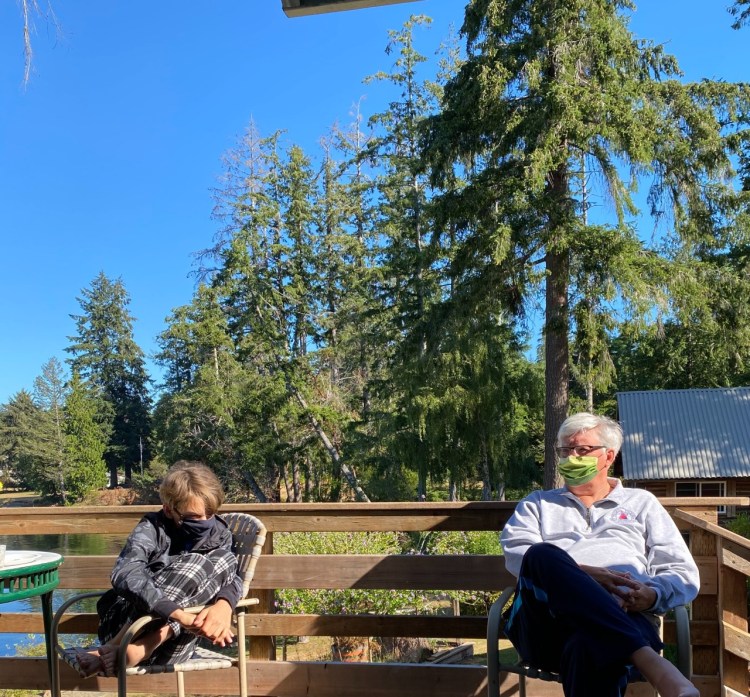
I surveyed the scattered remnants of our own breakfast; crusted cereal
bowls that might appeal to a scavenging chipmunk, half-empty coffee
mugs, and an empty plate with traces of frosting left behind by someone
who thought, “I think I’ll have cake for breakfast. After all, it’s summer.”
Our vacation was a heroic feat in the midst of the pandemic. We all agreed
to quarantine for two weeks, before we arrived. We agreed to zone the
house, one family per floor in the three-story A-frame, built fifty years ago
and recently renovated. We agreed to wear masks at all times inside,
socially distance, and forgo outside visitors while there, only family.
We lazed about, relaxing, and semi-planning the day, until my grandson
broke the calm.
“Hey, how long have we been here? Is it ten days yet? That’s how long we
have to distance before we know we’re safe! Right?”
He looked at his mother for guidance, “Can we hug them? I mean Poppa
and LaLa. Can we hug them yet?”
“Yes!” We all jumped up and bear hugged each other, shed more than a few
tears, and celebrated our survival. “I love you,” we shouted. Words could
barely convey our joy.
Good Enough
As we anticipated Christmas, the United States had surpassed eighteen
million cases of Covid-19 and reported 319,000 deaths. Even though, we
were all healthy, we agreed that inside celebrations were not the best of
ideas. Christmas in our own homes would have to be good enough this year.
After we decorated our home, I wandered from room to room and enjoyed
our traditional tree ornaments and wreaths in our windows, but I felt
forlorn. Our plan was not good enough for me. After a few days, I broke the
agreement and asked, “Can we try something else?”
On Christmas Eve, when my son’s family arrived for lunch, all the outside
doors in our house were open, screens back on the storm doors to allow
outside air to filter through the house. I counteracted the chill and turned up
the furnace, just for the hour or two, we would be together. I’d conserve
tomorrow.
My husband and I sat masked in our designated zone, the entry hall. We
carried in a small patio table and adorned it with a holiday cloth. From
there, we visited with our family in their zone, the living and dining rooms,
all within our sight. One at a time, we served ourselves a holiday lunch,
most of it take-out, spread across the kitchen island, alongside paper plates,
cups, and napkins, and disposable cutlery.
After we opened gifts, my grandchildren said, “This is a great Christmas,
LaLa and Poppa! We love our gift certificates from Dick’s Sporting Goods.
We can order online and they have curbside pickup. They’ll bring our
presents right out to us, sort of like Santa!”
It was an enjoyable day. It was good enough for us.
I Know. Onward.
My legs were just long enough to step from one yellow circle and the next
chalked circle in the parking lot of Brookdale retirement community down
the street from my home. While vaccinating their own residents in late
February, their medical director extended an invitation to nearby neighbors
“of a certain age” to also get vaccinated. Like frogs leaping from one lily pad to another, seeking safety and a good landing, my neighbors and I were
back again, seeking safety and our second Pfizer Covid-19 vaccination.
After we finished, we lingered, in no hurry to walk back to our homes. Still
masked, we marveled at our good fortune. “This is so wonderful. Can you
believe it?” someone mused. A few of us replied, “I know, I know! How
lucky we are!”
For the first time in a long time, we felt like we were trekking onward, not
up a mountain, but down the other side.
 Judith Barker Kvinsland