By Judith Barker Kvinsland
On the night before Thanksgiving, nearly six months after my mother died, the Pacific Ocean unleashed a storm on the northern California coast, unlike any other I had ever seen. I was still a newcomer in California, but I had been forewarned.
“Winter storms around here are brutal,” new friends and colleagues cautioned me. “Heavy, rain filled cloud banks roll in between November and March. They’re harsh. Don’t be surprised if you have to pull your car off the road and wait them out. Highway 1 will flood, parking lots, too.”
I shrugged away their warnings with a smile and a flippant reply, “Oh, I’m from Western Washington, Puget Sound country. I’m used to rain and storms. Don’t worry about me.”
Little did I know, until the first winter storm of the year arrived that Thanksgiving Eve. Puget Sound rainstorms, while often dreary and endless, are hardly devastating. As I pulled into the parking lot of the local market after work, I encountered blinding rain and churning floodwaters, dimly lit by light poles swaying in the wind. I chose a spot, as close to the entrance as I could find, and shoved the car door open. I peered down into the debris-laden, filthy water and swore to myself, “I’ve got to get these groceries! It’s Thanksgiving, damn it! I can do this.” I slid away from the comfort of my warm, dry seat and plunged into the flood that was now six inches deep and rising. No longer able to see my shoes, I slogged toward the market’s entrance.
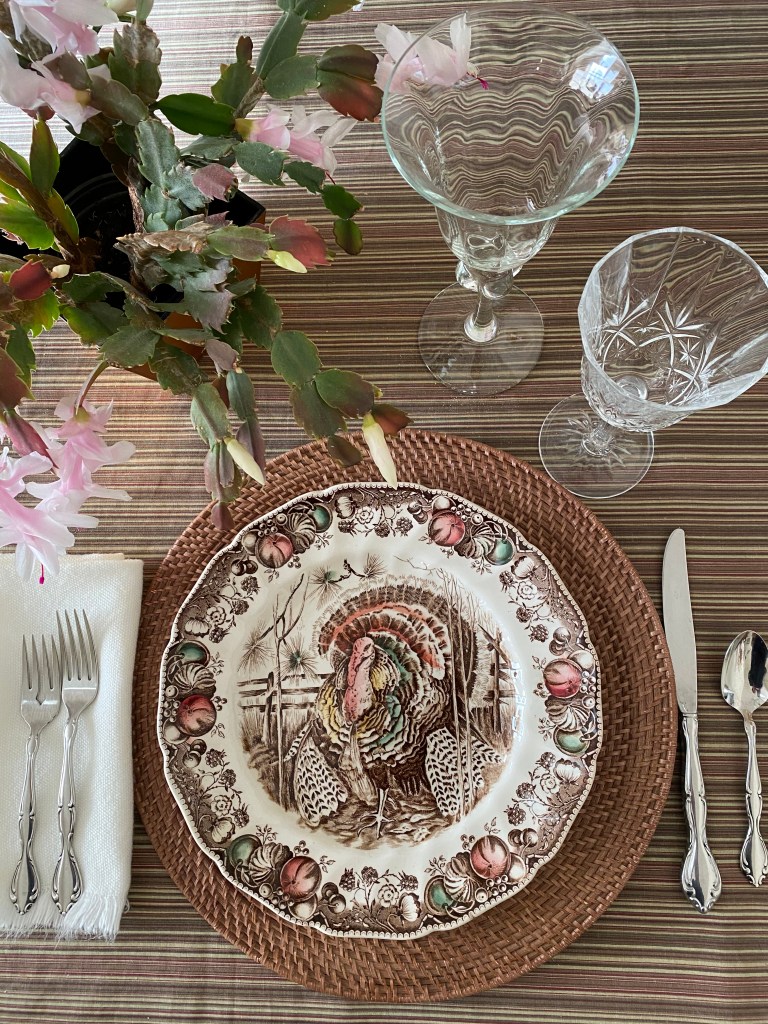
Not only was I treading on physically shaky ground that year, but to my real detriment, I was still struggling on emotionally shaky ground as well, protecting myself from reality. My mother was gone. My mother who knew how to stuff a turkey just perfectly, so a delectable crust formed on top of moist breadcrumbs, was gone. My mother who set an elegant Thanksgiving table with lace tablecloths and ironed napkins was gone. My mother who called all of her children before Thanksgiving to remind us to bring containers to take home leftovers was gone. My mother, who gave me her holiday-themed, Thanksgiving china, shortly before she died, was gone. As her oldest child, I was the heir apparent. On this first holiday without her, I mourned my mother deeply.
The market was brightly lit in contrast to the darkness outside. I grabbed a cart and pulled my wrinkled grocery list out of a pocket. Somehow, I found the strength to work my way down the list; pre-ordered turkey, check. Cranberries, Yellow Finn potatoes, fresh green beans, canned pumpkin, oodles of whipped cream, check. I selected northern California wines from nearby Anderson Valley: Pinot Noir, Chardonnay, and Sauvignon Blanc. I pushed my cart around the edge of the market, ticking off the items on my list, intent upon fulfilling my task, even though I was wet and bedraggled.
I rounded the corner toward the checkout lines and barely dodged an industrious, young clerk positioning a tiered cart, loaded with floral holiday arrangements. The memory of other Thanksgivings swirled about me, like the last of the autumn leaves blowing outside. With the memory of my mother’s gracious Thanksgiving table imprinted upon me and the recollection of centerpieces I brought her every year, I wandered over to the display. I pondered, “Which one would Mom like for the table?” I gazed at glossy pumpkins filled with autumn foliage and chrysanthemums. I picked up colorful vases and asked myself, “Is this one too tall? Will we be able to see over it and talk to each other?” I worked my way around the colorful display until I found the perfect choice: a straw basket planted with a lush, green vine, laden with clusters of bright orange berries, trained to grow in the shape of a wreath. Pleased with my selection, I nestled the basket atop my cart.
I sensed something was amiss. I felt confused and overwhelmed by my actions. I felt lost, even before the young clerk gestured toward my chosen arrangement and politely asked, “Who’s the lucky person who gets that one?” My throat tightened. I couldn’t speak. I noticed everyone around me chatting, smiling, and wishing each other “Happy Thanksgiving.” At that moment, I felt the loss of my mother, more deeply than ever before. Clearly, I was delusional: “If I buy this Thanksgiving centerpiece, everything will be fine. If I buy it, will it bring my mother back?” I burst into tears. l abandoned my cart and fled outside, back into the storm. Murky water sloshed about me as my own tears dripped into the flood.
I don’t remember how long I sat alone in my car that night, sobbing and mourning my mother on the first holiday without her. When I finally got out of my car, I realized that the storm had moved inland, away from the coast. I remember stars peeping out, shimmering overhead as the sky began to clear. I remember reentering the market and finding my abandoned cart, in the same aisle where I left it, the centerpiece perched on top. I remember surveying the cart, making sure everything I needed was still inside. I remember the efficient checker who gently set my treasured plant aside as she began to ring up my purchases. I remember her confirmation, “That basket is lovely. It’s the nicest arrangement that came in this year.” I remember pulling myself together, finally able to whisper, “I’m buying it in memory of my mother. She died this year. I really do miss her.” The checker stopped her work, surveyed my sodden clothing and swollen, tear-streaked face, and gently inquired, “Are you going to be all right, dear?” I remember assuring her, and ultimately, myself, “Yes, I think so.”
The next afternoon, I gazed around our Thanksgiving table at my family, all chattering, laughing, eager to sample and savor the familiar holiday entrees we had created earlier. Sunlight streamed through the overhead skylights and cast a warm glow on the centerpiece I had chosen the night before. “It’s beautiful,” everyone agreed. As we passed the traditional delicacies around, I heard my daughter wonder, “Don’t we have Grandma’s Thanksgiving china somewhere? We should be using it.” I took a deep breath, gathered up all of my strength, and concurred, “Yes, I think so. We need do that. Maybe, next year?
 Judith Barker Kvinsland