By Judith Barker Kvinsland
The summer that I turned six-years-old, my parents bought our family home, a
fifty-year-old shingled craftsman perched on a hillside in tiny Harper, Washington on
the Kitsap peninsula mainland, about seven miles from the town of Port Orchard. It had
a sweeping view of Puget Sound, Blake Island, and West Seattle. Our town had two
claims to fame; one was the convenience of a Washington State Ferry terminal located
at the foot of our weed-filled lawn. Every weekday morning, my father loped down our
hill at 5:45 a.m. to catch the Klahanie, the ferry that serviced the Harper-Vashon-
Fauntleroy route to Seattle in the 1950’s. Like many of our neighbors, he commuted to
the city for work.
The other benefit was the presence of Harper Grocery and Service, just a five minute
walk from our home, only two minutes for me, since I was usually running. The
small general store also served as a post office where my brother and I traveled each
day to get our mail, each of us clutching a nickel for ice cream. Best of all, I learned
that Harper Grocery and Service was one of the bi-weekly, summer stops of the Kitsap
County Regional bookmobile. I was elated.
It was hard for me to contain my six-year-old excitement the first time the
massive library on wheels pulled up before me and a few other regulars who clutched
their books to return. To this day, I can hear the clunk of the metal steps descending
from their hiding place beneath the chassis. I can still hear the whoosh of the door as
it folded open. I can still visualize the driver, not particularly interested in more than
keeping the vehicle level, the fans running, and providing us safety, as he gazed out his
window at Puget Sound. But my fondest memory is the smiling librarian, who
welcomed us aboard, greeted me for the first time, showed me the picture book
section, and skillfully redirected me when I whispered, “I can read.” I left that day with
all the books I could carry, no limits imposed, and once the librarian learned of my
interests, she arrived every two weeks, with a stash of books she had chosen, just for
me.
For the next ten summers, I never missed a day when the bookmobile visited
Harper. Many years later, when I wrote my memoir, Disturbing the Calm: A Memoir of
Time and Place and acknowledged the influencers in my life, I included: “The kind
librarians aboard the Kitsap Regional Library Bookmobile who overlooked the rules and
allowed a young girl to check out as many books as she could carry, up the hill to her
home in Harper.”
On the morning of my last day of third grade, the tide was in, or up again, as salt
water kids on Puget Sound liked to describe its daily action. From our bus stop, near
the local Harper Grocery and Service, we watched the briny froth lap over a nearby,
granite rock where we would soon gather daily for three delightful months to dive,
splash, and frolic.
I bent down and breathed deeply into the red velvet petals of untended, wild
rose bushes beginning to bloom in the rock-filled ditch adjacent to our bus stop. I
pulled. I tugged. I twisted, until I gathered a small bouquet. I even considered making
a corsage and pull the plaid ribbons out of the ends of my braids, to bind the stems
together.
I speculated; Mrs. Wilson will like these roses. She will smile, perhaps pull me
close for a hug, as she admires their beauty. I had enjoyed a wonderful year in her
class, despite my difficulty to master multiplication.
The creaking screen store of Harper Grocery and Service flung open and a
neighbor, known to not be particularly tolerant or fond of children, stomped toward me,
leaving his car at the nearby gas pump:
“Hey, those don’t belong to you. Knock it off! You kids, all of you, leave things
alone!”
I wilted. The roses wilted as I dropped them on the ground and lowered my
gaze. Humiliated, tears rolled down my cheeks.
Minutes later, I stared through the windows of the belching yellow school bus as
his car crunched over the fallen roses, as he roared away from the gas pumps.
Since that day, I’ve never cared for red roses, nor planted any in my gardens.
On a blazing July afternoon, while I was still in junior high school, I
lazed about on our lawn with friends, waiting for the tide to come in. We were summer
berry pickers, girls who were earning money for school clothes, girls who tediously
picked strawberries in the morning at a local farm, then wild blackberries as we walked
home, selling them to grocers in Harper and South Colby, who would then sell them to
their customers, eager to savor hard-to-find, wild blackberries in their homemade pies.
We knew that the salt water of Puget Sound had the amazing ability to remove
the stains from our hands. We knew that the red welts and scratches on our arms and
legs, acquired by wading through brambles, could be soothed by salt water. We felt
the tedium was worth it, as we fantasized about the clothing we would choose at
nearby Bremer’s, or across the Sound at the Bon Marche, Rhodes, or Frederick and
Nelson in Seattle.
Deep into our school shopping plans, I barely glanced at the two runabouts, just
offshore, persistently chasing each other in the choppy surf, zooming over waves,
somewhat dangerously it seemed, until one of the boats broke away and slowly began
to cruise back and forth on our beach. To my surprise, it was That Guy; That Guy who
had started walking me to my bus and carrying my books, as the year had ended, That
Guy who had started calling me every night, That Guy who I was looking forward to
seeing again when school resumed.
As my friends watched, I self-consciously walked down to the shore, berry
stained and scratched, but he didn’t seem to notice as he asked, “Hey, would you like
to go for a boat ride with me?”
I gasped, “You’ve come all this way by water? How did you know where I live?”
“You said you lived above the ferry dock, and I guessed which house was yours.
Then I saw you on the lawn. How about it?”
Just then, his friend, who I later learned had casually invited himself on the
journey from Waterman to Harper, buzzed up so close, that being on the water that day
felt dangerous. He took a sudden turn, leaving us both drenched.
I said, “Maybe lose your friend, and then ask me again.” That Guy came back
the next day, and many days afterward.
We have owned and enjoyed eight different boats during our fifty-seven years of
marriage, sailing, rowing and and motoring with family and friends on Puget Sound, in
the San Juan Islands, and on northern California lakes and rivers.
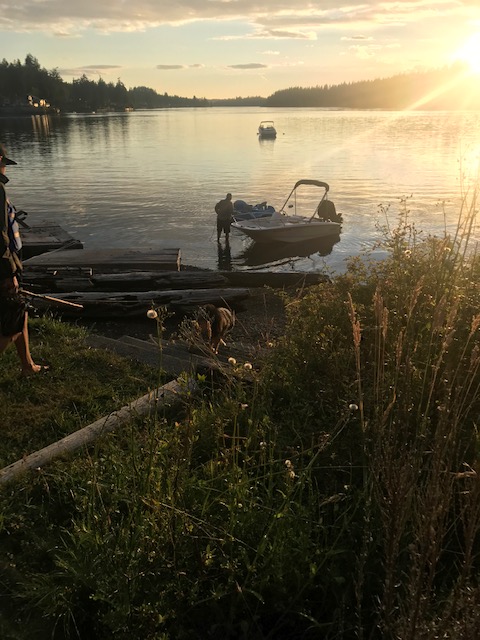
A few days ago, we watched our grandchildren secure our current boat to a
buoy, drag rowboats out of the water and tie them to a raft, gather up assorted paddle
boards, oars, wakeboards and life jackets, then carry the kayaks up to the lawn as we
ended another great summer day.
I asked That Guy, “Do you think we should check on the lines and knots?”
“Nah, they know what they’re doing. Nothing to worry about. We’ve taught them
well.”
 Judith Barker Kvinsland