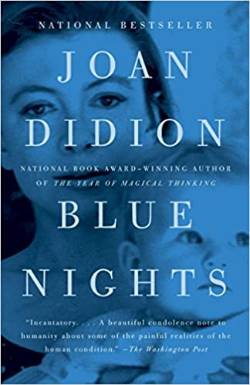
Blue Nights by Joan Didion
Reread in January 2022, following her death in December, 2021
When I learned that Joan Didion had died on December 23, 2021, at the age of 87, I halted my last minute holiday preparations. I wandered over to one of my bookcases and pulled “Everything Didion,” off a wide shelf that had been occupied, mostly by her. I was not surprised that this day had arrived, since Didion was 87 and had been in ill health for some time, but I was saddened just the same. I sunk down on the carpet, lovingly clutched every book of hers, and eventually stacked them into an honored pile, commemorating her as best as I could. As the holidays progressed, I found a few minutes to thumb through every book revisiting her brilliance, revisiting her insights.
During the first few weeks of the new year, I set upon the business of rereading, not all of Didion, but the ones from my shelf, as well as rewatching the Netflix documentary, “The Center Will Not Hold,” directed by her nephew Griffin Dunne. “Blue Nights” was the book that stuck with me the most during this process, not the one I would have expected, but it revealed itself to be, perhaps the most personal of all of her writing. Dedicated to her daughter, Quintana Roo, an only child, the dedication in Blue Nights is simple, “This book is for Quintana,” and begins, “July 26, 2010. Today would be her wedding anniversary.” Didion, painfully, reflects upon her thoughts, fears and doubts about having children, the loss of a child, illness, and growing old. I can not say more to give homage to Joan Didion, but to encourage you to read this, her most personal of meditations, and in her words, “This book is called “Blue Nights” because at the time I began it I found my mind turning increasingly to illness, to the end of promise, the dwindling of days, the inevitability of fading, the dying of the brightness. Blue nights are the opposite of the dying of the brightness, but they are also its warning.” It is a book by a writer who possessed and wrote with some of the most observant of social and political eyes, that in this book, turned personal.
 Judith Barker Kvinsland