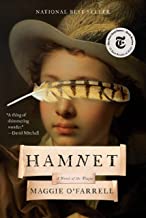
Hamnet: A Novel of the Plague by Maggie O’Farrell
Read February, 2021
In the middle of a pandemic, on a devastating day when 500,000 American lives have been lost, reading and reviewing a book about The Black Death, the deadly plague in England in the 1580’s, makes no sense at all. Why would one be drawn to the topic? Perhaps because it was written by the talented Maggie O’Farrell, with eight, successful books already published. O’Farrell, who was raised in Wales and Scotland, now lives in Edinburgh, Scotland. What’s another reason? Perhaps because it illuminates the early, somewhat ambiguous life of William Shakespeare. Or, a third reason, perhaps because the NYTimes Book Review chose it as one of the “10 Best Books of 2020.”
To be fair, Ms. O’Farrell’s book was published in July, 2020, about six months after we learned to associate the coronavirus with Wuhan and about four months after our country went into quarantine from coast to coast, as did the world. Anyone who writes a book knows that the process of writing that leads to publication, especially by one of the biggies, in this case, Alfred A. Knopf, can be a project that takes years from start to finish. It is a brilliant book. How timely are her thoughts. I can not stop thinking about it.
O’Farrell opens her novel of historical fiction with a Note to her readers:
1) In the 1580’s, a couple living on Henley Street, Stratford, had three children: Susanna, then Hamnet and Judith, who were twins. (Full disclosure, I liked my first name, Judith, a lot better when I learned a number of years ago that Shakespeare gave that name to one of his two daughters!)
2) The son, Hamnet, died in 1596, aged eleven.
3) Four years or so later, the father wrote a play called Hamlet ( a name interchangeable with Hamnet, at that time in history).
We know that Shakespeare was a mere grammar school graduate, the eldest son of a glove maker, and a penniless Latin tutor, when he met and married Anne (also called Agnes) Hathaway, an extraordinary, eccentric young woman, whose social class and circumstances were much more favorable than his own.
Like its times, and like current times, it is a novel of grief; how we experience it, how we respond to it, and the damages it causes within the wide net of family and community. For the reader, there are highs and lows, but even in the worst of times, “the most shattered heart might find some solace, some healing.” (Reviewer: Geraldine Brooks, NYTimes, November 23, 2020).
Consider reading this book, if it’s the only piece of fiction you read this year.
 Judith Barker Kvinsland